

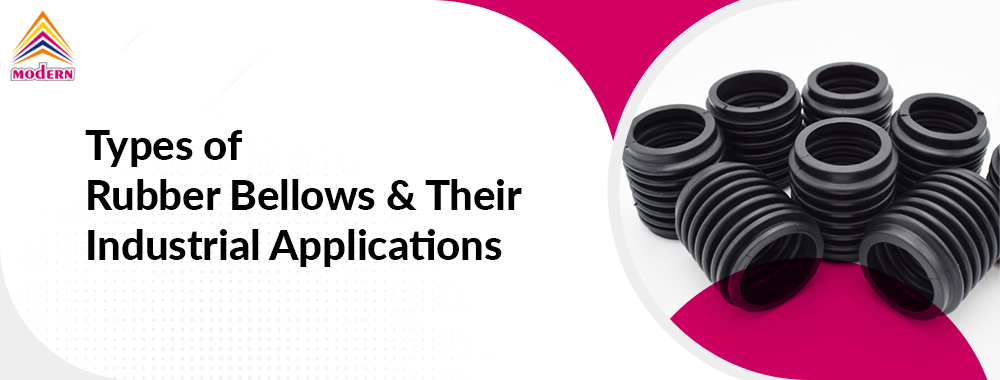
Rubber bellows are critical elements that are meant to deal with issues such as vibration, dust resistance, misalignment, and sealing the mechanical systems. Popular as industrial rubber bellows, they assist in enhancing the performance of equipment and improving service life through the control of movement among the parts. A trusted rubber bellow manufacturer will make sure that such parts will be made to be durable and flexible in harsh conditions. In this guide, we will discuss the various varieties of rubber bellows, their materials and their major industrial applications to guide you in selecting the right solution.
What Are Rubber Bellows?
Rubber bellows is a flexible material that allows movement, vibration absorption, and facilitates easy mechanical action. They are commonly applied in automotive, industrial, and OEM applications where they are required to have controlled movement and to be durable. These components are appreciated in such markets as rubber bellows India, where they are appreciated due to their capability to work under harsh conditions. In order to know what automotive rubber bellows are, they are usually applied in systems such as steering systems, where flexibility and predictable performance are necessary to ensure efficient operation and the extended life of the components.
Types of Rubber Bellows
Rubber bellows come in different types according to their design/shape and the method of manufacturing, which assists industries to select the appropriate type according to flexibility, movement and application requirements.
1. Conventional (Accordion) Rubber Bellows
Convoluted rubber bellows are accordion-shaped, highly flexible and move smoothly. They are the easiest to use since they can easily be stretched, compressed and bent. They are commonly applied in steering columns, shafts and industrial machines that need constant motion and directional control.
2. Expansion Rubber Bellows
Expansion bellows are made to accommodate the thermal expansion and contraction in piping systems. They eliminate stress and avoid damage in HVAC, water treatment and chemical processing applications. These rubber bellows applications are usually flanged to allow easy installation.
3. Automotive Rubber Bellows
Vehicle systems that incorporate automotive rubber bellows include CV joints, rack and pinion, and shock absorbers. In order to know what automotive rubber bellows are, they aid movement and maintain smooth movement. Automobile rubber bellows play the most important roles in terms of flexibility, alignment and durability, particularly when crafted out of EPDM or Nitrile materials.
4. Protective Rubber Bellows
In machines, such as CNC machines, actuators and cylinders, protective rubber bellows are employed to cover and protect machine parts. They assist in the smooth working of industrial systems and lessen the wear of an industrial system.
5. Molded Rubber Bellows
Compression moulding or injection moulding is used to make molded rubber bellows with accurate shapes and uniform quality. They are ideal for OEM applications requiring accuracy and reliability from a trusted rubber bellow manufacturer.
6. Custom Rubber Bellows
Tailor-made rubber bellows are created to meet the needs of unusual sizes. Those who are custom rubber bellow manufacturers have the ability to offer custom solutions where they use materials such as Nitrile, which makes them unique when it comes to specialized industrial use.
Industrial Applications of Rubber Bellows
The rubber bellows are commonly used in different industries according to their requirements. Some of the most popular industries that use these bellows are given below.
Automotive Industry
CV joints, steering racks and exhaust systems have rubber bellows that facilitate easy movement and lifespan. These car tire bellows are used to assist in sustaining performance in dynamic car parts.
Manufacturing & Machine Tools
Protective bellows are employed in CNC machines, spindles, and actuators to ensure the consistent operation as well as minimize the wear of the moving parts.
HVAC & Piping Systems
To manage thermal expansion and minimize vibration in pipeline, expansion bellows are employed to stabilize a system in HVAC and fluid systems.
Chemical & Process Plants
Custom and reinforced bellows are used in these industries to handle pressure variations and challenging operating conditions.
OEM Supply
Applications that demand precision and consistency like the OEM plastic components are made of molded rubber bellows which are offered by the major manufacturers of rubber bellows in India.
How to Choose the Right Rubber Bellows Material for Your Application
Before you buy any rubber bellows according to your requirement, there are some points which you need to consider that are listed below.
Operating Temperature
The Rubber bellow must be chosen depending on the range of temperature of the application since various materials react differently to heat and cold.
Chemical Exposure
When using oils, fuels or chemicals, then it is worthwhile to select a material that can resist these materials without degradation.
Type of Movement
When it is known that either there is an axial, lateral or angular movement needed in the application, this can be used to choose the appropriate design to ensure a smooth-running application.
Pressure Rating
The bellows should be in a position to withstand the high pressure so that it becomes stable and durable and does not fail in the process.
Custom Requirements
By collaborating with a manufacturer of custom rubber bellows, the product will be made to the correct material, size, and performance requirements of your application.