

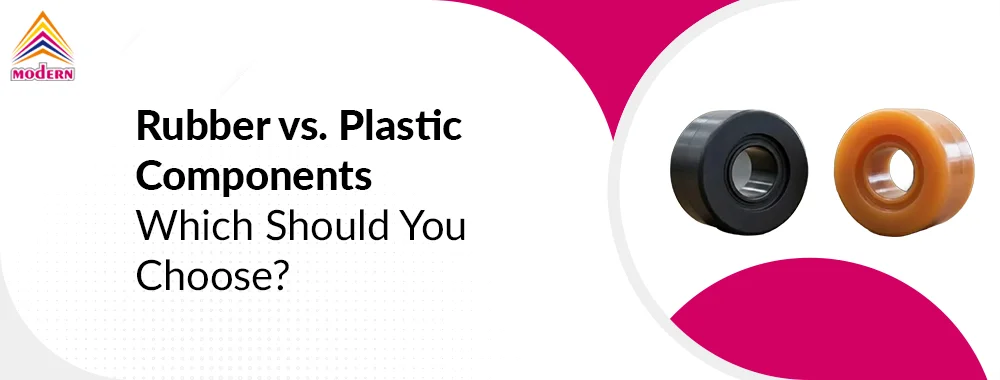
If you've landed here trying to decide between rubber and plastic for a part you're about to draw up or source, you've probably already read a materials-science explainer or two. Most of what's out there is written by resin suppliers and masterbatch companies, and it's usually accurate on the chemistry, but it rarely gets to the question you actually have: given this specific part, this load, this temperature range, which material do I spec? This guide is written with rubber moulded parts and plastic injection moulded parts in mind, as we make both types in-house. Before choosing between rubber and plastic you need to check that the material must move, seal or absorb shocks, plastic when things must stay in a definite shape under pressure. Everything below is an explanation why and where these two categories overlap.
Rubber vs. Plastic: Property Comparison Table
Here's the side-by-side we wish existed when we started sourcing materials for customer drawings. Treat the numbers as a starting reference, not a spec sheet — always confirm against the datasheet for the exact compound or resin grade you're specifying.
| Property | Rubber (Elastomer) | Plastic (Thermoplastic) |
|---|---|---|
| Elasticity / elongation at break | Very high, typically up to 1000%+ | Low, typically under 100% |
| Behavior relative to Tg | Used above its glass transition temperature, highly elastic state | Used below its glass transition temperature, rigid glassy state |
| Manufacturing process | Compression, transfer or injection moulding, then vulcanization (curing) | Injection moulding, extrusion or blow moulding, finished directly |
| Typical service temperature range | Roughly -50°C to 150°C, grade-dependent | Varies widely by resin, generally a narrower elastic response range |
| Dimensional stability / rigidity | Lower, flexes and deforms under load, recovers shape | Higher, holds precise shape and tolerance under load |
| Best suited for | Sealing, vibration damping, flexing, shock absorption | Structural parts, housings, precision components, low-friction parts |
| Recyclability | Limited for vulcanized (thermoset) rubber, TPE/TPV are recyclable | Generally more readily recyclable (thermoplastics) |
Manufacturing Process Differences
The two categories are made differently, and that difference shows up in lead time, tooling cost and design flexibility. Plastic components are almost always injection moulded, extruded or blow moulded, and in all three cases the part comes out of the process essentially finished, with its final shape and mechanical properties set the moment it cools. That's part of why plastic tooling can move fast once a design is locked.
Rubber takes an extra step. A rubber part is typically compression or transfer moulded (or injection moulded, for higher-volume runs) into its rough shape, and then vulcanized, which means curing it with heat and a crosslinking agent, usually sulfur, to lock the polymer chains together into a network. That network is exactly what gives cured rubber its elasticity and its resistance to compression. Skip or under-cure this step and you get a part that looks right but performs poorly in service, which is one reason rubber sourcing has a slightly steeper learning curve than plastic sourcing for buyers who are new to it.
When to Choose Rubber Components
Reach for rubber whenever the part's job depends on it deforming and then bouncing back. In practice, that covers a handful of recurring categories:
Sealing and gasketing. O-rings, flat gaskets and oil seals all rely on compression set performance, meaning the material needs to stay compressed against a mating surface for years without permanently flattening out. This is rubber's home turf.
Vibration damping and shock absorption. Bushings and anti-vibration mounts absorb energy from a moving assembly instead of transmitting it into the frame or housing around it. A rigid material can't do this job; it just transmits the vibration straight through.
Dynamic flexing applications. Bellows and diaphragms flex thousands or millions of times over their service life, and they need a material that recovers its shape on every cycle without fatiguing or cracking.
Wide, stable temperature-elasticity range. Most general-purpose rubber compounds stay usably elastic from around -50°C to 150°C, which is a genuinely wide window compared to how narrow a plastic's elastic response tends to be outside its design range.
When to Choose Plastic Components
Plastic is the right call whenever the part's job is to hold a shape, carry a load without deforming, or run against another surface with minimal friction. The recurring categories here look almost like the mirror image of rubber's:
Structural housings and enclosures
Anything that needs to stay dimensionally stable under its own assembly load, an electrical enclosure or a bracket, needs the rigidity that only a below-Tg material provides.
Precision components with tight tolerances
If a part has to mate repeatably within a few hundredths of a millimeter, plastic's dimensional stability is what makes that achievable at scale, in a way that a flexible material simply can't guarantee.
Lightweight parts where rigidity matters more than flex
Where weight is a constraint but the part still has to hold its form, engineering plastics give you strength-to-weight ratios that rubber can't match.
Low-friction and wear applications
Bearings and bushings machined from UHMWPE or Polyacetal (Delrin/POM) run smoothly against a mating part with very little lubrication needed, which is a job rubber isn't built for.
High heat or chemical resistance in a rigid form
When a part needs to stay dimensionally stable while sitting in an aggressive chemical environment or at sustained high temperature, resins like PTFE and PPS do the job rubber compounds generally can't.